

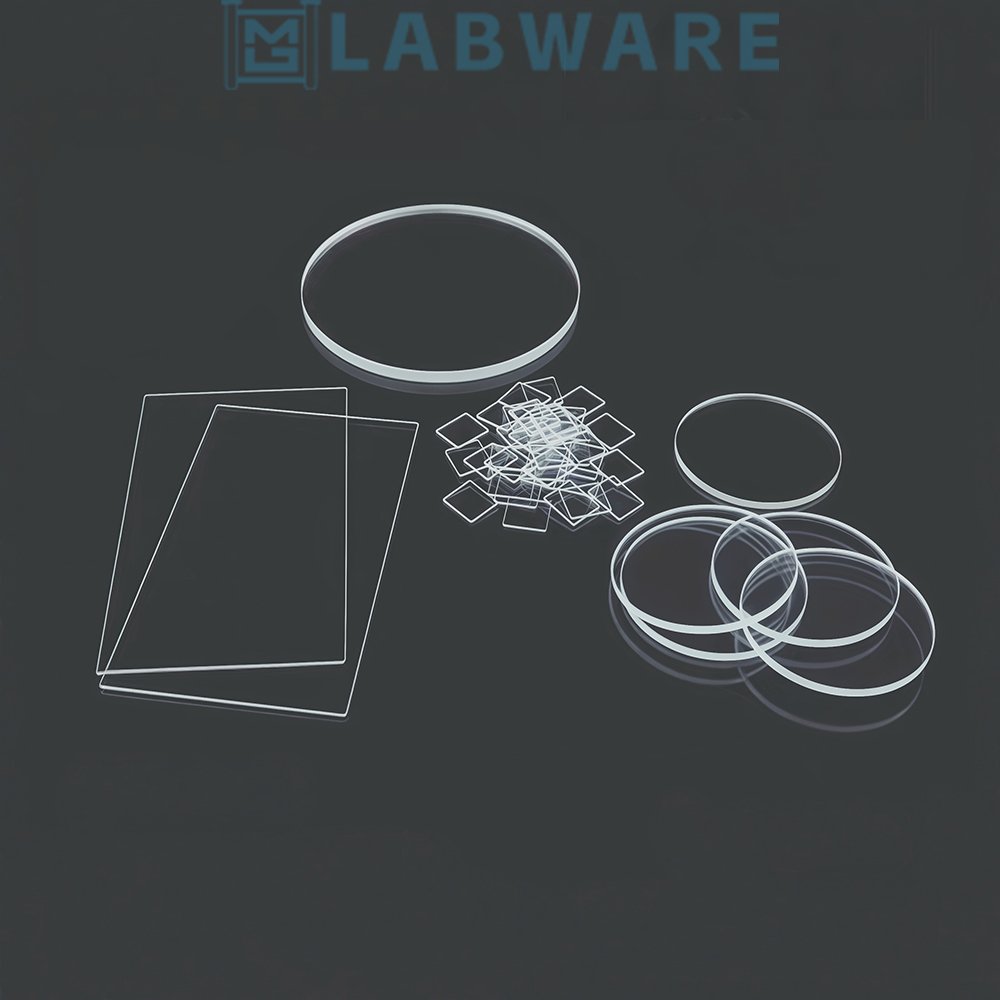
Fused Quartz Glass Plate & Disc JGS3
Price range: $10.00 through $553.00
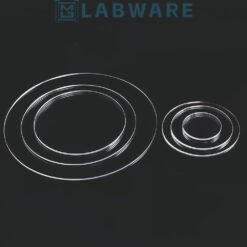
- Type: Fused Quartz Glass Plate & Disc JGS3
- Made of: 99.999%SiO₂
- Feature: strong acid & alkali resistance/1000°C working temp./best transmitting band 300nm-3500nm
- Order Processing Time: 3 to 5 work days
- Customization:available
- Item NO.: M26222
Fused Quartz Glass Plate & Disc JGS3
Plate, Size: L=length*W=weight*T=thickness
Disc, Size: D=diameter*T=thickness
All polished: polishing six faces to clear
Our JGS3 Fused Quartz Plates and Discs are engineered from high-purity natural crystal, offering exceptional optical clarity and performance for demanding ultraviolet (UV) to infrared (IR) applications. This material is synthesized through meticulous electric fusion, achieving superior transmission in the UV spectrum with excellent physical and thermal stability.
JGS1 (Synthetic Fused Silica)
-
Production: Made via chemical vapor deposition (CVD) from high-purity gases like SiCl₄.
-
Key Property: Extremely low hydroxyl (OH) content (<10 ppm) and metal impurities.
-
Spectral Feature: Excellent deep-UV transmission, with a cutoff wavelength as low as ~160 nm. No significant OH absorption peak in the infrared.
-
Primary Application: Precision optics for deep-UV lithography (e.g., 193nm, 248nm), excimer laser components, and space-based UV instruments.
JGS2 (Hydrogen-Oxygen Flame Fused Glass)
-
Production: Made by melting natural quartz or crystal in a hydrogen-oxygen (H₂/O₂) flame.
-
Key Property: Contains a medium level of hydroxyl (OH) content (~150-400 ppm).
-
Spectral Feature: High transmission in the “solar-blind” UV range (220-280 nm) and visible spectrum. Has a strong OH absorption peak at 2.73 µm, making it unsuitable for that IR wavelength.
-
Primary Application: General-purpose UV optics, such as lenses, windows for UV spectroscopy, UV detection, and standard laser components.
JGS3 (Electrically Fused Silica)
-
Production: Made by melting natural quartz sand in an electric furnace under vacuum or inert atmosphere.
-
Key Property: Low OH content but contains more bubbles and inclusions. Higher metallic impurity levels.
-
Spectral Feature: Poor UV transmission (cutoff ~260 nm or higher). Usable in the visible to infrared range, but with reduced optical homogeneity due to inclusions.
-
Primary Application: Cost-effective infrared windows, viewports for furnaces, and other applications where high optical precision is not critical.
| Type | UV Performance (Short Wavelength) | UV Performance (Short Wavelength) | Optical Homogeneity | Primary Application Field |
| JGS1 | Best (Transmits deep-UV) | Best (No OH absorption) | Excellent | Deep-UV Lithography, Precision Optics |
| JGS2 | Very Good (Transmits UV above ~210 nm) | Poor (Strong OH absorption) | Very Good | General UV & Visible Optics |
| JGS3 | Poor (UV cutoff ~260 nm+) | Good (Low OH) | Fair | IR Windows, Industrial Viewports |
JGS1 is for deep-UV excellence, JGS2 is the standard for most UV/VIS applications, and JGS3 is a budget choice for IR/visible applications not requiring high precision.
| Weight | N/A |
|---|---|
| Size | 10mmx10mmx0.5mm(10pcs), 10mmx10mmx1mm(10pcs), 10mmx10mmx2mm(10pcs*all polished), 10mmx10mmx3mm(10pcs*all polished), 15mmx15mmx0.5mm(10pcs), 15mmx15mmx1mm(10pcs), 20mmx20mmx0.5mm(10pcs), 20mmx20mmx1mm(10pcs), 25mmx14mmx1mm(10pcs), 25mmx25mmx0.5mm(5pcs), 25mmx25mmx1mm(5pcs), 30mmx30mmx0.5mm(5pcs), 30mmx30mmx1mm(5pcs), 40mmx40mmx0.5mm(5pcs), 40mmx40mmx1mm(5pcs), 50mmx50mmx0.5mm(3pcs), 50mmx50mmx1mm(3pcs), 80mmx80mmx2mm(3pcs), Round 32mmx1.5mm(5pcs), Round 50mmx10mm(2pcs), payment link for customization |
Be the first to review “Fused Quartz Glass Plate & Disc JGS3”
Related products
Quartz Frit
Quartz Glass

Quartz Glass
Half-Height Quartz Glass Square Cylinders Tanks for Industrial Furnaces & Processing & UVC
Reviews
There are no reviews yet.