

Calcium Fluoride
Detailed Explanation of the Transmitting Wavelength of Calcium Fluoride Windows
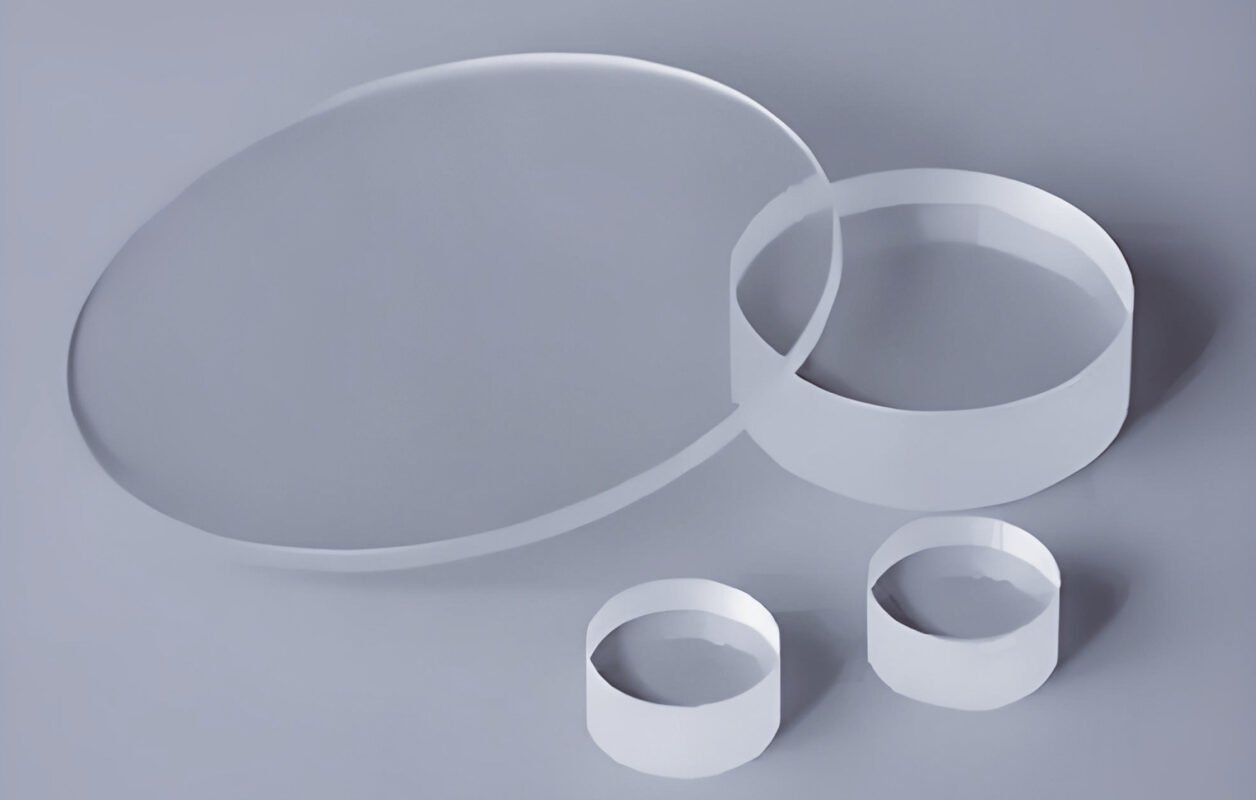
- Transmitting wavelengthof calcium fluoride windows
Calcium fluoride (CaF2) is a material that is widely used in optical windows, and its core advantage lies in its light transmittance over a wide wavelength range. The transmission wavelength range of calcium fluoride is 50,000-1000 cm-1, corresponding to wavelengths of 0.2-10 μm. This covers the ultraviolet (UV), visible light (VIS) and mid-infrared (MIR) wavelengths. The specific manifestations are as follows:
(1) Ultraviolet light wavelength (50000-25000 cm⁻¹, 0.2-0.4 μm)
Calcium fluoride glass still maintains a relatively high transmittance (>90%) in the deep ultraviolet region and is suitable for use in laser excimer systems.
- Visible light to near-infrared light wavelength (25000-4000 cm⁻¹, 4-2.5 μm)
Calcium fluoride glass is renowned for its consistent transmittance within visible light to near-infrared light wavelength, which consistently exceed 95%. This makes it an optimal choice for use in spectrophotometers.
- Mid-infrared light wavelength (4000-1000 cm⁻¹, 5-10 μm)
Calcium fluoride glass exhibits a gradual decrease in transmittance of 80% within mid-infrared light wavelength, yet remains a superior option when compared to the majority of infrared materials.
- The key factors influencing transmittanceof calcium fluoride glass
- Material purity
High-purity (≥99.99%) calcium fluoride glass has the capacity to reduce impurity absorption peaks, especially in the 2500-2000 cm-1 (4-5 μm) wavelength range. For instance, oxygen-containing impurities can cause an absorption band within the wavelength range of 6.3 μm.
- Thicknessof calcium fluoride glass
An increase in the thickness of calcium fluoride glass will reduce its transmittance, especially in the long-wave region. Experiments have demonstrated that the transmittance of a 1 mm thick calcium fluoride window at the light wavelength of 10 μm is approximately 15% lower than that of a 0.5 mm thick window.
- Temperature stability
Calcium fluoride is known to cause a shift in the transmission due to thermal expansion at high temperatures in excess of 300°C. For every 100°C increase, the transmission cut-off side moves approximately 50 cm⁻¹ towards a lower wavelength.
- Typical application scenarios and data comparison
The transmitting characteristics of the calcium fluoride window make it suitable for the following fields:
- Fourier transform infrared spectroscopy (FTIR)
The most commonly used wavelength is 4000-400 cm-1 (2.5-25 μm), and this must be combined with a low-absorption CaF2 window (transmittance >85%).
(2) Laser optical system
For example, the ArF laser (193 nm, approximately 51800 cm⁻¹) usually utilizes a calcium fluoride window, with a damage threshold of 5 J/cm².