

Quartz Glass
Optical Quartz Glass JGS1, JGS2, JGS3-Key Differences
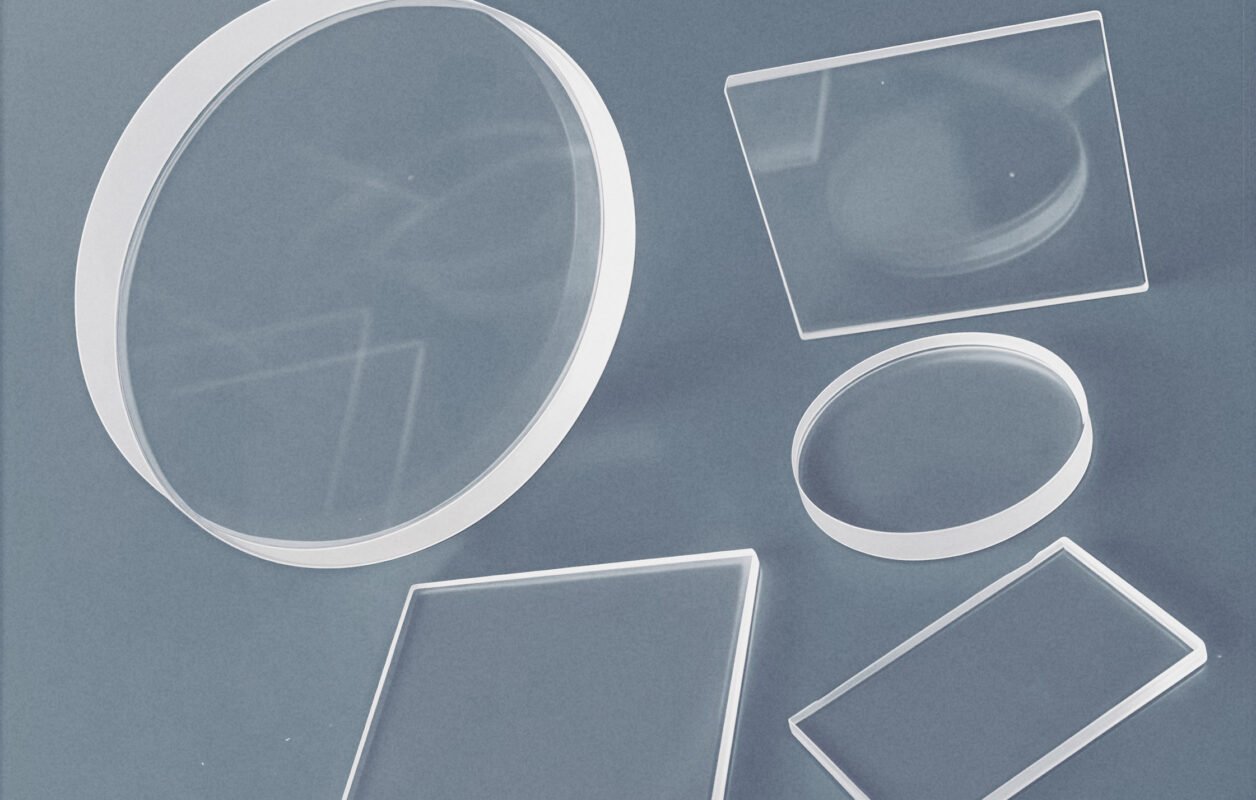
JGS1, JGS2 & JGS3 are Chinese national standard designations (from GB/T 18371-2001) for three primary types of fused quartz glass, distinguished mainly by their production method, impurity content, and resulting ultraviolet (UV) transmission performance. They are the functional equivalents of internationally known grades like Corning 7980, Suprasil, and Spectrosil.
The core difference lies in the presence of metallic impurities and hydroxyl (OH) groups, which dramatically affect the UV transparency.
1. JGS1 (Equivalent to Fused Silica Type III)
-
Production Method: Made from high-purity silicon crystal (Si) that is vaporized and fused in a hydrogen/oxygen (H₂/O₂) flame. This process introduces hydroxyl (OH) groups into the glass matrix.
-
Key Characteristics:
-
High OH Content: Typically ~1000 ppm.
-
Excellent UV Transmission: Superior performance in the deep UV region. Its transmission is high down to about 185 nm.
-
Low Infrared (IR) Transmission: The high OH content causes strong absorption bands in the IR region (e.g., at 2.7 μm, 1.38 μm).
-
Purity: Very low metallic impurity content.
-
-
Primary Application: Optical components for ultraviolet applications, such as lenses, windows, and substrates for photolithography (e.g., microlithography at 193 nm ArF excimer lasers).
2. JGS2 (Equivalent to Fused Silica Type II)
-
Production Method: Made from high-purity natural quartz crystal or sand that is fused in a hydrogen/oxygen (H₂/O₂) flame or an electrical furnace.
-
Key Characteristics:
-
Moderate OH Content: Lower than JGS1, typically in the range of 150-400 ppm.
-
Good UV Transmission: Transmits well from about 220 nm to 250 nm and upwards. Its cutoff is at longer wavelengths than JGS1 due to trace metallic impurities from the natural raw material.
-
Better IR Transmission than JGS1: Fewer OH-related absorption bands than JGS1, but not as good as JGS3.
-
Purity: Contains more metallic impurities (e.g., Al, Fe) than JGS1 or JGS3, limiting its deep UV performance.
-
-
Primary Application: Optical components for the near-UV to visible spectrum, such as lenses, prisms, and windows for general optics and instruments.
3. JGS3 (Equivalent to Fused Silica Type I)
-
Production Method: Made from high-purity silicon compound (often silicon tetrachloride, SiCl₄) that is vaporized and fused in a plasma flame or anhydrous electrofusion. This is a water-free (low-OH) process.
-
Key Characteristics:
-
Extremely Low OH Content: Typically <5 ppm, often referred to as “dry” or “synthetic” silica.
-
Poor Deep UV Transmission: Opaque below ~280 nm due to intrinsic structural defects (lack of OH to passivate them). Transmission becomes excellent from the near-UV (~250-350 nm) through the visible and into the infrared.
-
Excellent IR Transmission: The lack of OH groups eliminates the strong IR absorption bands, making it the best choice for infrared applications up to ~3.5 μm.
-
Highest Purity: Extremely low metallic and ionic impurities.
-
-
Primary Application: Optical components for infrared systems, laser optics for high-power lasers (like CO₂ lasers at 10.6 μm), and applications requiring low fluorescence and excellent bulk homogeneity.
Summary Comparison Table
| Feature | JGS1 | JGS2 | JGS3 |
|---|---|---|---|
| Main Raw Material | Synthetic Silicon Crystal | Natural Quartz Crystal | Synthetic SiCl₄ |
| Production Method | H₂/O₂ Flame Fusion (Wet) | H₂/O₂ Flame or Electric Fusion | Plasma/Electrofusion (Dry) |
| OH Group Content | High (~1000 ppm) | Medium (150-400 ppm) | Very Low (<5 ppm) |
| Best Transmission Range | Deep UV to VIS (185 nm – 2.1 μm) |
UV to VIS (~220 nm – 2.5 μm) |
NUV to IR (~280 nm – 3.5 μm) |
| Key Strength | Excellent Deep UV Trans. | Cost-effective for UV-VIS | Excellent IR Trans., Low Fluorescence |
| Weakness | Strong IR Absorption | Lower UV cutoff than JGS1 | Opaque in Deep UV |
| Typical Application | Microlithography, Deep UV Optics | General UV-VIS Optics, Lamps | IR Windows, High-Power Laser Optics |
In simple terms:
-
Choose JGS1 for the best deep ultraviolet (below 220 nm) performance.
-
Choose JGS2 for good UV performance (above 220 nm) at a lower cost.
-
Choose JGS3 for the best infrared performance and for high-power laser applications where low absorption and thermal stability are critical.