
micglass material features banner

Labware Material Features

Our labware is crafted from premium borosilicate glass, fused quartz and specialty plastics, etc. Each material is selected for specific strengths: chemical inertness, thermal shock resistance, optical clarity, or mechanical durability. This ensures reliable performance, from precise measurements to reactions under extreme conditions, guaranteeing purity, safety, and accuracy for every protocol.
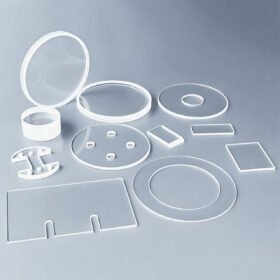
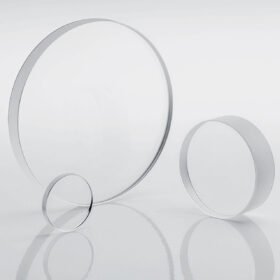
Fused Quartz Glass

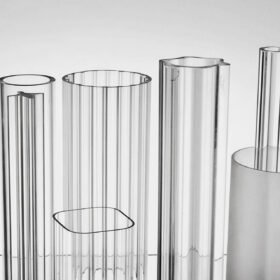
micglass material fused quartz glass

Fused quartz glass, synthesized from high-purity silica sand or silicon tetrachloride, is an amorphous, single-component material renowned for its exceptional combination of properties derived from its strong silicon-oxygen bonds and non-crystalline structure.

  • Physical Properties: Its most defining characteristic is an extremely low coefficient of thermal expansion (≈0.55 x 10⁻⁶/°C), making it virtually immune to thermal shock. This allows it to withstand rapid temperature changes from over 1000°C to room temperature without cracking. It has a high softening point (~1680°C) and excellent long-term dimensional stability. While hard and rigid, it behaves as a brittle solid.
  • Chemical Properties: Fused quartz exhibits superior chemical purity and inertness. It is non-hygroscopic and offers outstanding resistance to most acids, salts, and halogens (except hydrofluoric acid and hot phosphoric acid). Its high purity minimizes contamination in sensitive processes, and it shows very low rates of weathering or leaching in water and atmospheric exposure compared to other glasses.
  • Optical Properties: It is a premier optical material with a wide, continuous transmission range from the deep ultraviolet (~170 nm) through the visible spectrum and into the near-infrared (~2.7 μm, with OH-dependent absorption peaks). Its high transparency and low autofluorescence are critical for UV applications. It possesses a low refractive index (~1.458 at 587.6 nm) and exhibits minimal birefringence under stress.

In summary, fused quartz glass is an enabling material where extreme environmental challenges meet the need for precision. Its unique synergy of near-zero thermal expansion, supreme chemical resistance, and broad-spectrum optical transparency makes it indispensable in semiconductor fabrication, precision optics, laser systems, laboratory ware, and aerospace instrumentation.

Sapphire glass, technically single-crystal aluminum oxide (Al₂O₃), is an exceptional synthetic material prized for its extreme durability and high performance across demanding applications.

Physical Properties: Its most renowned attribute is exceptional hardness, ranking 9 on the Mohs scale, second only to diamond. This grants outstanding scratch and wear resistance. It possesses high mechanical strength, excellent stiffness, and good thermal conductivity. While it has a high melting point (2050°C), its thermal expansion coefficient is moderate (~6 x 10⁻⁶/K), requiring careful design for thermal shock management despite its good high-temperature stability.

Chemical Properties: Sapphire exhibits superior chemical inertness. It is highly resistant to most acids, alkalis, and corrosive agents at room temperature, with notable exceptions being hydrofluoric acid and hot phosphoric acid. It demonstrates excellent resistance to weathering, oxidation, and erosion from molten metals and salts, ensuring long-term stability in harsh environments.

Optical Properties: It is a premier wide-band optical material with a broad transmission windowspanning from the deep ultraviolet (~150 nm) to the mid-infrared (~5.5 μm). This makes it ideal for UV, VIS, and IR applications. It has high refractive index (~1.76 at 550 nm) and excellent optical clarity. A key characteristic is its birefringence (double refraction), which must be accounted for in precision optical systems by using specific crystal orientations (like the c-plane).

In summary, sapphire glass combines unparalleled surface hardness, superb chemical resilience, and excellent optical transmission. This unique synergy makes it the material of choice for high-end watch crystals, semiconductor wafer carriers, armored windows, aerospace sensors, and robust laser optics.

Sapphire Glass

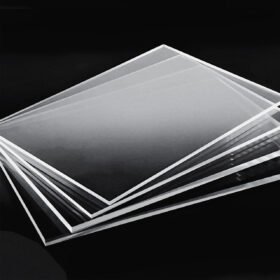
micglass material sapphire glass

Borosilicate glass

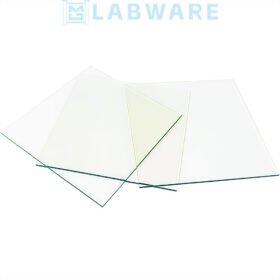
micglass material Borosilicate glass

Borosilicate glass is a specialized silicate glass distinguished by its significant boron trioxide (B₂O₃) content, typically 12-15%. This composition is the key to its unique and valuable set of characteristics, making it a staple in scientific, industrial, and domestic applications.

  • Physical Properties: The defining physical feature of borosilicate glass is its very low coefficient of thermal expansion (≈3.3 x 10⁻⁶/K). This property, approximately one-third that of ordinary soda-lime glass, grants it excellent resistance to thermal shock. It can withstand rapid and extreme temperature differentials without fracturing, enabling direct transfer from a hotplate to a bench. It has a higher softening point (~820°C) than common glass, enhancing its thermal durability.
  • Chemical Properties: This glass exhibits high chemical durability and inertness. It is highly resistant to water, acids, halogens, and organic solvents, outperforming standard glass in withstanding chemical corrosion. Its low alkali content minimizes leaching or ion exchange, making it ideal for storing pharmaceutical and chemical reagents. However, it is vulnerable to prolonged exposure to hydrofluoric acid, hot concentrated phosphoric acid, and strong alkaline solutions.
  • Optical Properties: Standard borosilicate glass offers good transparency in the visible spectrum, though its transmission range is narrower than fused quartz or sapphire. It typically transmits well from around 350-400 nm in the near ultraviolet through the visible and into the near-infrared (~2.5 µm). While not used for high-precision optics, its clarity is sufficient for laboratory glassware, sight glasses, and lighting applications. Special low-iron formulations can achieve higher clarity for enhanced optical performance.

In summary, borosilicate glass’s balanced and practical combination of superior thermal shock resistance, strong chemical stability, and adequate transparency makes it the material of choice for laboratory equipment (e.g., beakers, flasks), high-quality cookware, industrial sight glasses, and technical lighting components, where durability under thermal and chemical stress is paramount.